MEDLINK connects registration, wards, pharmacy, labs, billing and dozens of other departments — across one hospital or an entire regional network — into a single live system, sharpened by AI clinical intelligence and IoT-connected devices.
MEDLINK started as a bed-tracking spreadsheet for a single 40-bed regional hospital. Today it is a multi-hospital management platform: one Super Admin can oversee an entire regional health system, while each hospital, branch and satellite clinic still runs its own wards, pharmacy and billing without waiting on head office.
Underneath the day-to-day workflows sits a layer of AI clinical intelligence and IoT device integration — flagging the patient likely to deteriorate before the chart shows it, and streaming ICU monitor readings straight into the record. We are not a generic ERP with a medical skin — every screen, permission and report is designed around how hospitals, and the ministries that oversee them, actually run.
Every workflow is reviewed by practicing clinicians before release, not just product managers.
Your hospital owns and controls its data at all times, with full export and audit access.
Lab analyzers, PACS, insurers and payment gateways connect without custom development.
A dedicated implementation team stays with your hospital through go-live and beyond.

From the ward round to the pharmacy counter, one system follows the patient everywhere they go.
Ward Management
Nursing & Staff
Pharmacy
Patient Care
Bed Management
Facilities
Ward Management
Nursing & Staff
Pharmacy
Patient Care
Bed Management
FacilitiesEvery department below — including AI clinical intelligence and IoT-connected devices — reads and writes to the same patient and hospital record, across as many facilities as your network runs.
MEDLINK is built to run one hospital or a whole regional network from the same platform. A Super Admin governs standardized protocols and resource sharing across every facility, while a layer of AI quietly reviews every chart in the background — flagging risk, suggesting diagnoses and predicting where the next bed shortage will happen.
Onboard new hospitals, branches and satellite clinics under one governance layer, with standardized clinical protocols and shared resources across the network.
Reviews the chart alongside the doctor — surfacing likely diagnoses, flagging dangerous drug interactions and recommending treatment protocols in the moment they're needed.
Looks ahead of the admission log — forecasting bed and drug demand, scoring readmission risk, and predicting disease outbreaks from early regional trends.
Nine distinct user roles, from Super Admin down to Patient, each scoped to exactly the modules and records they need — nothing more.
Staff clock in and out by simply walking past a camera at the ward or department entrance — no shared badges, no buddy-punching, and no manual attendance sheets to reconcile.
The frontline modules your registration desk, outpatient department and nursing staff use every hour of every day. This is where a person becomes a patient record, where appointments are booked and kept, and where day-to-day nursing documentation happens at the bedside instead of on paper that gets copied later.
The single source of truth for every patient who walks through your doors — from first registration through years of returning visits, admissions and discharges.
Patients book online or at the desk, staff manage the queue in real time, and doctors can see patients remotely without leaving the same record system.
Bedside charting that keeps every shift honest — vitals, medication rounds and handovers are logged the moment they happen, not reconstructed at end of shift.
Built for the moments that can't wait — rapid triage, trauma protocols and ambulance dispatch are tracked from the first call to the handover at the ER doors.
Every reason a patient walks in — OPD consult, follow-up, IPD admission, emergency — is classified and tracked as a single visit, even when it touches five departments in one day.
Once a patient is admitted, they move through beds, wards, theatres and sometimes intensive care — often within the same day. These modules keep bed occupancy, surgical scheduling and critical monitoring in sync so a bed is never double-booked and a ventilator reading is never lost between shift changes.
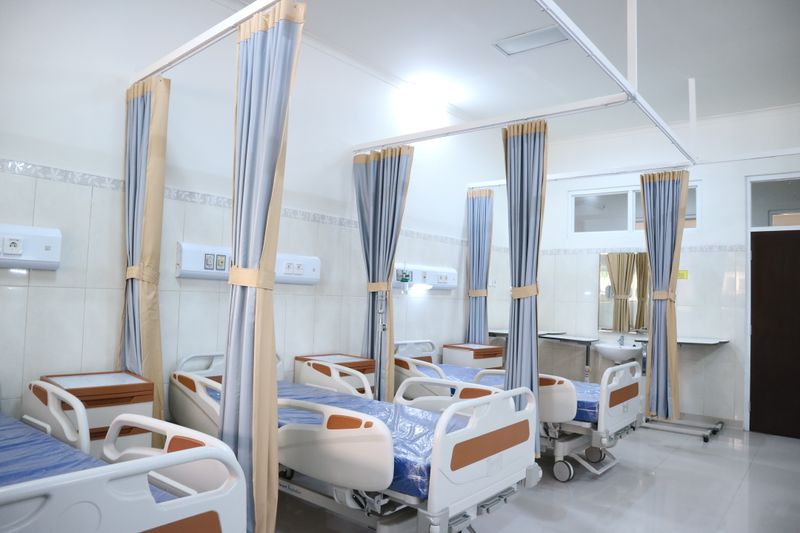
A live map of every bed in the hospital — who's in it, when it was last cleaned, and where the next available bed is, without a single phone call to the ward.
Continuous, minute-by-minute charting for your most critical patients, with automatic alerts when a reading moves outside a safe range.
Follows a mother and baby from first antenatal visit through delivery and postnatal check-ups, keeping both records linked from day one.
Growth and vaccination charts built specifically for children, linked to school health records so a child's care history follows them, not just their chart number.
Coordinates surgeon, anaesthetist, theatre and equipment so surgeries start on time and every implant or consumable used is captured for billing and stock.
Test requests, imaging and specialist therapy sessions are where hospitals often lose the most time to paperwork and courier delays. These modules connect the request straight from the doctor's order to the lab or imaging bench, and push results back into the patient chart the moment they're signed off.
From barcode sample collection to critical value alerts, the lab module keeps pathology, microbiology and blood bank on one shared results pipeline.
X-ray, CT, MRI and ultrasound requests, worklists and reports live in one place, with PACS integration so images open beside the report, not in a separate viewer.
Schedules machines and chairs against staff availability, and logs every session's consumables so recurring patients are never double-booked.
Tracks a patient's treatment plan across multiple sessions, so progress from week one is visible to every therapist who sees them afterward.
A dedicated odontogram and imaging workflow for dental teams, kept inside the same patient record as every other department.
Tracks every unit of blood from donor to transfusion, with cross-matching safeguards and a fast path for emergency requests when minutes matter.
Keeps every child and adult vaccination on schedule, tied to vaccine stock levels so a due dose is never missed for lack of supply.
Medicine has to be in the right place, in date, and accounted for — from the moment it's ordered from a supplier to the moment it's handed to a patient. These modules track every box from procurement through central store, ward stock and the pharmacy counter, with batch and expiry tracking built in rather than bolted on.
From e-prescription to dispensing counter, with automatic drug interaction checks and a point-of-sale that handles both walk-in and inpatient orders.
Central store visibility across every ward and department, with batch-level tracking so nothing expires unnoticed on a back shelf.
Turns a department's purchase request into an approved order, a supplier quote and a goods-received note — all traceable back to who asked for what.
Tracks every piece of equipment from ventilators to autoclaves — its maintenance schedule, calibration due date and which department it currently belongs to.
Care doesn't stop at the hospital wall. These modules extend MEDLINK out to patients at home and specialists at other facilities — through video consultations, connected wearables, and a referral system that closes the loop instead of losing the patient between two hospitals.
Video consultations, remote prescriptions and chat-based follow-ups, all logged into the same patient record as an in-person visit.
Wearables and bedside monitors stream vitals directly into the chart, so a deteriorating reading reaches a nurse before the next scheduled round.
MEDLINK's own remote monitoring programme — chronic disease and post-discharge patients wear a connected device at home, and their care team watches for warning signs long before the next scheduled appointment.
Sensors placed across buildings and equipment watch the hospital itself — catching a failing chiller, a water leak or a stuffy ward before it becomes an incident report.
Sends a patient to a specialist or partner hospital with their full history attached, and brings the outcome back to the referring doctor automatically.
One gateway for every SMS, email and WhatsApp message the hospital sends — appointment reminders, emergency alerts and results notifications alike.
Every clinical action in MEDLINK — a test, a bed-night, a dispensed medicine — quietly becomes a billable line item behind the scenes, so your finance team isn't chasing charge sheets from six departments at month end. Insurance claims and patient payments flow through the same ledger, reconciled automatically.
A full chart of accounts and general ledger built around hospital billing, so clinical charges post automatically instead of being re-keyed by hand.
Accepts cash, card, mobile money and bank transfer against the same invoice, and reconciles every channel automatically against the ledger each night.
Verifies membership at the front desk, routes pre-authorisation requests to the insurer, and tracks every claim from submission through settlement.
Behind every ward is a roster, a payroll run, and a set of permissions deciding who can see what. These modules manage the hospital as an employer and an organisation — staff records, department structure, and the access controls that keep sensitive patient data visible only to the right people.
Staff records, rosters and payroll for every role in the hospital, from consultants to housekeeping, with leave and performance tracked in the same place.
Configures the real structure of your hospital — OPD, Emergency, ICU, NICU, Paediatrics, Surgery, Cardiology, Neurology and more — as connected units, not silos.
Role-based access control down to the field level, plus a full audit trail so every view, edit and export of a patient record is accountable.
Tracks incidents, audits and accreditation readiness in one place, so quality reporting is a byproduct of daily work instead of a scramble before an inspection.
The final layer connects the hospital back out to the people it serves, and turns everything happening inside into decisions your leadership team can act on — patient self-service on one side, executive dashboards on the other, both drawing from the same live data.
Patients view their own records, book appointments, pay bills and download lab reports and prescriptions — without calling the front desk.
Executive dashboards blend clinical and financial KPIs, with predictive analytics that flag trends — like an upcoming bed shortage — before they become a crisis.
Connects to laboratory analyzers, PACS/DICOM imaging systems, insurance platforms and payment gateways through an open, documented API.
Rolls patient-level data up into regional and national reporting — outbreak heat maps, vaccination coverage and notifiable disease submissions aligned to Ministry of Health formats.
Every module above feeds two things running quietly underneath: an AI layer that reads the data as it arrives, and an IoT layer that gets it there in the first place.
MEDLINK's AI layer sits quietly behind every chart, comparing each new result and vital sign against thousands of similar cases. It doesn't replace clinical judgement — it narrows the search, surfaces the outlier, and gives a doctor or nurse a head start on the decision they were already about to make.
"3 patients on Ward B show early signs of deterioration in the next 24–48 hours."
Bedside monitors, ventilators and wearable sensors connect straight into MEDLINK, turning a reading on a screen into a data point in the patient's chart. Nothing needs to be copied down by hand, and nothing waits for the next round to be noticed.
"ICU Bed 4 — SpO₂ 91% and falling. Nurse Uwimana notified 0.4s ago."
We've done this enough times to know where hospital implementations usually go wrong — so we built the process to catch it early.
Our team spends time on your wards, not just in a boardroom, mapping how registration, admissions and billing actually flow today — including the workarounds.

Departments, roles, bed layouts, billing rules and insurance schemes are configured to match your hospital — not the other way around.

Existing patient records, stock levels and financial history are migrated and verified in a staging environment before anyone touches the live system.

Role-specific training for reception, nursing, pharmacy and finance teams — hands-on, on your hardware, before the switch is flipped.

An implementation specialist is on-site or on-call through your first weeks live, then hands off to our 24/7 support desk for the long run.

Everything you'd expect from an enterprise system, built around the reality of running a hospital around the clock.
Role-based access, full audit trails and encryption at rest and in transit, aligned with healthcare data protection standards.
Every module reads and writes to the same record — a bed status change in the ward shows up instantly at the front desk.
Fully responsive from the nursing station tablet to the finance office desktop, with no separate mobile app to maintain.
Executive dashboards with predictive analytics and live KPIs across every clinical and financial department.
Lab analyzers, PACS, insurance platforms and payment gateways connect through documented, supported APIs.
A dedicated support desk that knows hospitals don't stop at 5pm, staffed around the clock, every day of the year.
Join hospital networks of every size running their wards, pharmacy, finance, AI and IoT devices on MEDLINK.
Tell us a little about your facility and one of our implementation specialists will get back to you within one business day.
Whether you're running a 30-bed clinic or a 500-bed regional hospital, we'll walk you through what an implementation would look like for your team.
Thanks for reaching out — a member of our team will be in touch shortly.